What is perimenopause?
You asked: what is perimenopause
what is perimenopause
Researched
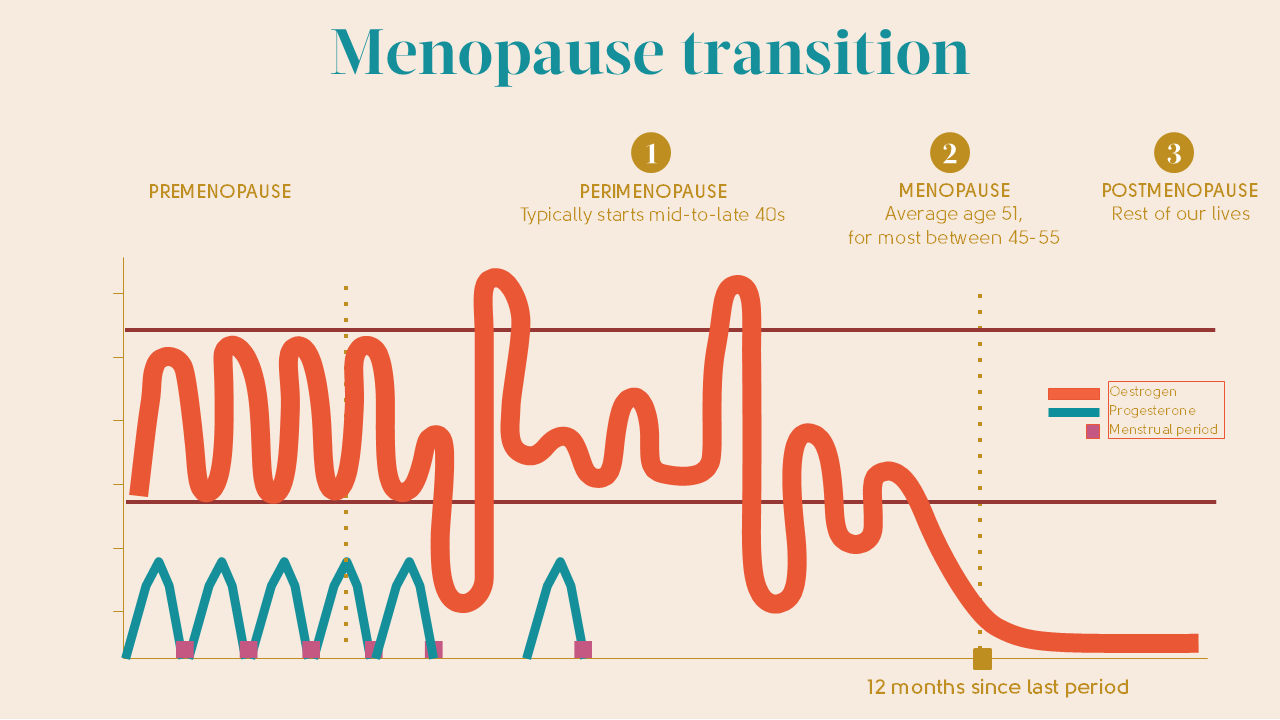
Perimenopause is the menopausal transition: the years before menopause when the ovaries’ hormone production changes and menstrual periods become less predictable. It is a normal life stage, not a disease. The term is sometimes used loosely as “menopause,” but they are not the same. [1]
Menopause is reached only in hindsight, after 12 straight months with no period or spotting. Perimenopause ends at that point. Most people begin the transition between ages 45 and 55, though the timing and length vary. [1]
What may change
A changing period is often the first sign. Periods may come closer together or farther apart, become lighter or heavier, last longer or shorter, or be skipped. These changes can happen because estrogen and progesterone levels fluctuate and then decline. [2] [1]
Some people have few symptoms. Others have symptoms that affect daily life, including:
- hot flashes or night sweats
- sleep problems
- vaginal dryness or discomfort during sex
- mood changes, irritability, or trouble concentrating
- joint or muscle discomfort
Symptoms and their severity vary widely. Having a symptom does not by itself prove that perimenopause is the cause. [1]
Pregnancy can still occur during perimenopause. Someone who does not want to become pregnant should continue birth control until they have gone a full 12 months without a period. [1]
When to seek medical advice
Period changes can be part of perimenopause, but they should not automatically be assumed to be harmless. Contact a health professional about bleeding or spotting between periods, after sex, very heavy bleeding, or periods lasting more than a week. Also seek care for any bleeding after menopause. [3] [1]
Seek emergency care if you soak through a pad or tampon every hour for more than two hours and have chest pain, shortness of breath, lightheadedness, or dizziness. [4]
A clinician can also help if hot flashes, sleep loss, mood symptoms, pain, or other changes disrupt your life. They may review symptoms and medical history, and sometimes use tests to rule out other causes of irregular bleeding or missed periods. [1] [5]
Sources
- 1.National Institute on Aging nia.nih.gov
- 2.American College of Obstetricians and Gynecologists acog.org
- 3.American College of Obstetricians and Gynecologists acog.org
- 4.American College of Obstetricians and Gynecologists acog.org
- 5.American College of Obstetricians and Gynecologists acog.org